
























Published August 2026
Cleaning up the laundry: Innovations in mitigating microplastic contamination from man-made fabrics

Microplastic contamination is widespread across our environment, and there are growing concerns about its effects on human health and ecosystems. In this article, we explore the issue of microplastic pollution originating from man-made fabrics, and innovations to prevent further contamination of the environment from this source.
What are microplastics and why are they a problem?
Microplastics are persistent plastic materials having a particle size range of <5 mm. Nanoplastics (which still lack a commonly agreed definition, though 1–1,000 nm is typically used) are sometimes considered separately [1].
Microplastics have been found in oceans and coastlines, rivers, and soil, as well as in the atmosphere. A scientific study released by Greenpeace in 2019 found that every one of the 13 UK rivers tested were contaminated with microplastics [2]. Concerningly, the contamination has even spread to places such as polar ice, and permafrost [3].
As a consequence, it’s no surprise that microplastics have found their way into our food chain and then our bodies, including our blood, lungs, and even in the placentas of pregnant women [4].
Scientists have raised concerns about the impact of microplastics on human health and the wider environment. Studies have shown that microplastics make soil less fertile, reduce food productivity, and ultimately impact the economy. It has also been shown that microplastics can slow the growth of phytoplankton, a microscopic marine algae which is the base of several aquatic food webs. One study also suggested that microplastics may speed the melting of snow and ice in places like the Arctic. This limits the planet’s ability to reflect sunlight and speeding global warming [5].
How do microplastics from man-made fabrics contaminate the environment?
One of the most abundant types of microplastics in the environment are microfibres from synthetic textiles and fabrics such as polyester [6], and it is estimated that by 2030, 73% of total fibre production globally will be synthetic fibres [7]. These synthetic fibres impart hugely beneficial properties to clothing and homeware, making them durable, strong, lightweight, resistant to wrinkling and pilling, and easy to make in a variety of colours.
However, when we do the laundry, a huge amount of microplastic contamination is washed into our water system via the washing machine effluent.
What is being done to mitigate the issue?
Some countries are taking steps towards preventing microplastic contamination from washing machines from entering the environment.
For example, France has mandated that all new washing machines from January 2025 must include a filter to capture microfibres [8].
In the UK, a “Microplastic Filters (Washing Machines) Bill” (here) has had its first reading in UK Parliament. This Bill would requires manufacturers to fit microplastic-catching to new domestic and commercial washing machines in order to prevent pollution into rivers and seas.
In addition, the EU has recently passed rules to limit microplastic discharges in wastewater treatment [9]. This may increase efforts towards preventing microplastic contamination in waste water sources.
What innovation activity exists which aims to mitigate the issue of microplastic pollution?
The EPO Report “Plastics in Transition” (here) provided as part of its Technology Platforms initiative (here) reveals interesting trends for innovations in dealing with waste plastic.
The subsection “Plastics waste recovery” reveals that patent filings relating to the removal of plastics, and in particular microplastics, from waste water has surged in the past 10 years.
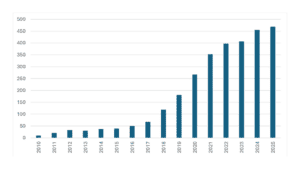
Figure 1 Graph showing the number of patent families published each year from 2010 to 2025 for an EPO search in respect of the removal of microplastics from water.
Therefore, there is clearly increasing interest in mitigating the release of, and removing, microplastics from waste water in the natural environment.
Is there any specific innovation for tackling the issue of microplastics from textiles and clothing?
Possibly as a result of the pending legislation, several companies are innovating in the provision of filters for both industrial and domestic washing machines.
Bristol-based engineering company Matter is focused on “Pioneering filtration technology to capture microplastics and cut carbon emissions”. Recently featured in the Guardian newspaper (here), Matter innovates and sells microplastic filters for use in domestic washing machines and for professional laundry services. The company has nineteen patent families (here) under the applicant name “Inheriting Earth Ltd” including granted GB and EP Patents, and several pending applications. Notably, EP4313354B1 relates to a separator for removing microfibers from washing machine wastewater. In addition, EP4073312B1 relates to a compactor for extracting and compressing microplastics from waste effluent. Impressively, Matter was a Finalist in the Earthshot prize in 2025 (here).
Other companies focused on reducing microplastic pollution from laundry include PlanetCare, who has a granted European Patent EP3655365B1 for a filter for removing microfibres from waste water from washing machines.
US-based company Cleanr has fourteen patent families (here) including several pending European applications, and a granted European Patent EP4489889B1 for a filtration device for filtering microplastics from washing machine effluent.
German-based company Ecofario develops innovative microplastic filtration systems based on the hydrocyclone principle for use in municipal and industrial wastewater treatment. There is a granted European Patent EP3612312B1 for a cyclone separator.
What other innovation is there?
The EPO search (here) also revealed several other methods for removing microplastic contamination from water, which have recently received patent protection in Europe:
- Proctor & Gamble and The Regents of the University of Michigan had a European Patent EP4171855B1 granted in 2025 for a method of removing microplastics or nanoplastics from a medium, for example laundry effluent, by contacting the medium with an article comprising one or more specified pressure sensitive adhesives.
- EP4049980B1 relates to a method of removing microplastics or nanoplastics from water by adding collagen material or a derivative thereof. The collagen material binds to the microplastic material, which forms a froth that can then be removed.
- EP4219018B1 relates to the removal of microplastics from an aqueous matrix using magnetic material such as iron. EP4469406B1 relates to a process of regenerating the magnetic material from magnetic material/microplastic aggregates resulting from the separation of microplastics from an aqueous medium using said magnetic material such as iron.
- EP3927665B1 discloses a method of monitoring and optionally controlling removal of microplastics from water comprising the steps of admixing a coagulant or polymer to the microplastics containing water, forming flocs, and/or aggregates, and separating said flocs or aggregates from the water.
In conclusion
Microplastic pollution, and particularly that originating from synthetic textiles, is a rapidly growing environmental challenge. Nevertheless, the increasing levels of innovation in preventing microplastic contamination into waste water is promising. As regulation and awareness increase, these technologies are likely to play an important role in protecting our environment and creating new commercial opportunities.
At HGF we have attorneys who specialise in all areas of industrial chemistry, many of whom have a keen interest in green chemistry. We are always excited to help with new inventions in the green chemistry field.
This article was prepared by Senior Patent Attorney Dr Jennifer Carlisle and Trainee Patent Attorney Anisha Patel.