

























Published April 2021
Copycat routes of action – decisive protection for designers
IPEC handed down a victory on 19th November 2020 to Italian manufacturer Freddy SpA. This company distributed a pair of trousers known as WR.UP pants (launched in 2012) – designed to lift and separate buttocks, thus enhancing the wearer’s bottom.
The garment also featured rubber support panels and waistband, not to mention unique seams and indicia present on the trousers. It is to be noted that the WR.UP pants were protected by patent and also had the benefit of UK unregistered design right (UK UDR). This case is note worthy because it achieved success with a “get-up” claim which can often be difficult for fashion/clothing items.
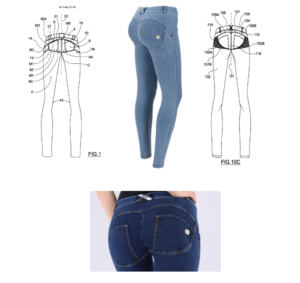
The defendant in this case was Hugz Clothing who were alleged to have manufactured and then sold trousers deemed highly similar to the WR.UP Pants. From the initial infringement, the parties entered into a settlement agreement in April 2019 prohibiting the sale of the said infringing trousers. However, this wasn’t the end of the story as a second pair of trousers were then released by Hugz soon thereafter and thus the settlement agreement was then breached (an additional claim won by Freddy at IPEC). The second pair did differ in design and for example featured a single diagonal belt loop and the curvature of the seams did not join in a central manner as before, so some differences were visually present. Despite this second version having some alterations which were visible, Freddy proceeded to launch infringement proceedings claiming infringement of the patent, UK UDR, passing off and also contractual breach of the settlement agreement. These claims were all denied by Hugz and they countered with a claim of groundless threats.
Key points from the claim/s:
Passing Off – the “get up” used by Freddy was similar to Hugz overall (in the vein of Jif Lemon thinking). It was argued that consumers would think the two brands were connected and those wearing the Hugz trousers would want other consumers to think they were actually wearing the WR.UP pants. IPEC agreed with this claim and found passing off in the traditional sense (the get up was recognised by consumers on sight of the trousers themselves) and also interestingly on the basis of post-sale confusion – this latter concept is being developed and used more and more in these type of cases and is useful for fashion items.
It doesn’t have to just be confusion at the direct point of sale, a product can be protected further downstream which moves the case law on from Arsenal v Reed[1] and more towards agreement with the decision in a New Zealand case involving Levi Strauss[2]. The key for brand owners will still be educating consumers so that they can identify a products origin and having good evidence of this. Therefore, for retailers, it is important to consider passing of at point of sale and also now post-sale, and to keep records of any instances of misrepresentation as this can help a claim to succeed.
UK UDR – Freddy put forward four aspects for this claim:
1. Shape of the trousers when worn by the consumer – perhaps important given designed to lift bottom;
2. Shape of the rubberised panel which was a support panel;
3. Shape and/or configuration of the upper rear part of the trousers; and
4. Shape and/or configuration of the trousers standalone (when not worn by consumer).
Interestingly, copying of the trousers was not denied but rather the defence put forward was based on exclusions available and attempting to invalidate the design (a standard go-to for design cases). Freddy was successful on 3 of the claims made above. IPEC did also make comment upon the concept of moving designs (confirmation that UK UDR does cover “moving” designs, e.g. transformable objects) and also must-match. With this latter concept, IPEC followed Ocular Sciences[3] and confirmed that the must match exclusion is really only to be brought into play as a defence when a product is designed to form a single article.
This case is overall good news for retailers, especially those who design fashion items, particularly if you are able to rely on a number of IP rights and run all of those in a claim, including putting any settlement agreements into play if a breach has occurred. Freddy was successful on a number of fronts and the decision assists designers with inventive and visually striking products, because even if a different brand name is used, the goodwill can still be tarnished and passing off made out.
Post-sale confusion assists, especially where it involves copycat designs and product ‘get up’. It is also interesting to note that comments on social media could assist so it is good to keep records of what people say about a potentially infringing product and this all helps the ‘get-up’ argument.
This case shows that although a passing off claim based on the get-up of a fashion item can be hard to prove, it should not be overlooked when considering a claim or dismissed when having to defend an action. Each case is based on its own facts and in this case, the look of the external jean design assisted greatly with the “get-up” claim.
Link to full case here.
[1] Arsenal Football Club PLC v Reed [2001] EWHC 440 (Ch)
[2] New Zealand: Levi Strauss and Co and Anor v Kimbyr Investments Limited [1994] FLR 335
[3] Ocular Sciences Limited and Anor v Aspect Vision Care Limited & Ors [1997] RPC 290
This article was prepared by HGF Trade Mark Director Rebecca Field.