

























CJEU clarifies the test for a new form of bad faith. Brand owners (and their trade mark teams) will have breathed a small sigh of relief when the long-awaited CJEU Judgement in Skykick was handed down at the end of January 2020 (find it here).
With the CJEU Judgement we found that lack of clarity and precision of the terms used to designate the goods and services of a trade mark (e.g., “computer software”) was not a ground of invalidity as being contrary to public policy.
However, the implications of the CJEU’s finding that a trade mark application made without any intention to use the trade mark in relation to the goods and services covered by the registration constitutes bad faith should be considered carefully by those with trade mark portfolios containing broad terms and/or expansive specifications.
The test set by the CJEU for this type of bad faith applied where it was clear that the applicant had filed the application not with the aim of engaging in fair competition but with the intention of undermining, in a manner inconsistent with honest practices, the interests of third parties, or even without targeting a specific third party, with the intention of obtaining an exclusive right for purposes other than those falling within the functions of a trade mark. Where such bad faith could be shown, this would not invalidate the entire trade mark but only the goods and services shown to have been applied for in bad faith.
Background
The case was referred by the UK High Court in an action where Sky Plc (the satellite broadcaster) claimed that SkyKick (at the time, a start-up company that supplied cloud migration information technology services) had infringed five prior EU and UK registrations for “SKY” use of the sign ‘SkyKick’:
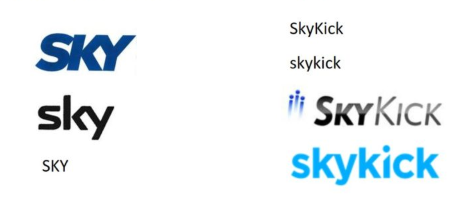
SkyKick counterclaimed that Sky’s registrations should be invalid, either in whole or in part, on the grounds that (i) the specifications lacked the requisite clarity and precision and (ii) the applications were made in bad faith. The Sky Plc marks at issue had very broad specifications covering thousands of goods and services across multiple classes and as such, Sky could not possibly have had an intention to use. Arnold J (as he was then) referred a number of questions to the CJEU concerning the role and function of trade mark specifications and bad faith filings.
What does this mean for brand owners?
This case highlights that it is important to strike the right balance when considering which goods and services to apply for in new registrations. When applying for a trade mark, businesses want to ensure that there is an element of “future-proofing” in terms of the goods and services they are applying for. A business plan might be structured to focus on one area and expand into other areas over time. Established businesses may be considering expansion into new areas of business and want to obtain new filings if clearance searches are positive. Within the retail environment, some wholesalers and supermarkets brands may have commercial rationale for extremely broad filings. Retailers also need to take into account how convergence and new technologies could impact on their business models and customer offerings. In such scenarios, a trade mark specification drafted to encompass such considerations, should still meet the requirements of indicating the quality or origin of the goods and services in question to the public. On grant, there is a five-year period of time to “use” the mark before it is vulnerable for revocation for non-use.
What might constitute bad faith following this Judgment? It is important to bear in mind that the CJEU’s Judgment is aimed at applicants whose filing practises aim to unfairly exclude third parties. That is through either targeting a known potential competitor or where the effect of the applicant’s actions is to exclude all competition in an area which is not justifiable based on the function of a trade mark. In its Judgment, the CJEU referred to the origin-indicating function but it is conceivable that other types of function could be considered.
In reality, the budget available for filing and maintaining registered trade marks across all territories will focus the majority of businesses on applying for what is truly required to protect a brand. In addition, it is increasingly difficult to avoid conflicts with other brand owners with registered protection if filings are too expansive. However, in a highly competitive environment, established brands might overreach in seeking to exclude any third party from using identical or similar marks beyond the business’ core areas, through expansive filings coupled with aggressive litigation and opposition strategies. Care must be taken in devising such strategies and it is important to maintain an objective view as to the extent of protection that is justified based on actual or proposed business activities.
Evergreening trade mark filings with broad terms and/or broad specification after five years to avoid having to provide proof of use in oppositions or being subject to counterclaims for revocation for non-use, might be problematic in light of this Judgment. Trade mark law already provides a route for well-known brands and marks with a reputation to prevent third parties taking unfair advantage or damaging key marks, as well as providing the ability to rely on unregistered rights in passing off. The fact that these tools are evidentially more burdensome and by their nature can have less certain outcomes, should not be a reason to seek unjustified registered protection.
To the extent that there may be registered marks within existing trade mark portfolios that are arguably affected by this Judgment, the CJEU has made it clear that they are only invalid insofar as they apply to goods and services applied for in bad faith. This means that core goods and services, which are genuinely important to the business, are not affected. However, trade mark owners would be wise to consider the impact of the Judgment on their existing portfolios, future filings and enforcement activities alongside a consideration of the reputational risk that they have acted in bad faith.