

























Published January 2025
Stripped of Stripes; Browne v Adidas
Back in March, we reported on the US and EU decisions in the ongoing disputes between Adidas and Thom Browne (see Retail Scanner article here).
In May, the US appeal courts refused Adidas’ requests for an appeal against the New York decision. More recently, we have had decisions from the UK and German courts, which are summarised below.
September 2024 – decision from the District Court of Nuremberg-Fürth
The German court concluded that the differences between the two sets of stripes – including the number of stripes and their width – were sufficient to prevent consumer confusion.
It was noted that Thom Browne’s target market was “discerning luxury consumers”. The prominent branding on Thom Browne’s website and the products themselves assisted in differentiating the products from those of Adidas.
November 2024 – decision from UK High Court
Here, the case was filed by Thom Browne and sought invalidation of sixteen registrations owned by Adidas. Adidas counterclaimed for trade mark infringement and passing off.
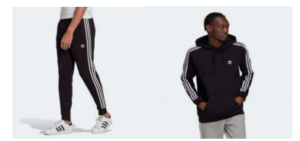
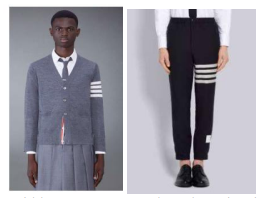
The Thom Brown specimens against the adidas mark asserted are included as an appendix to the judgment, but some examples shown below:
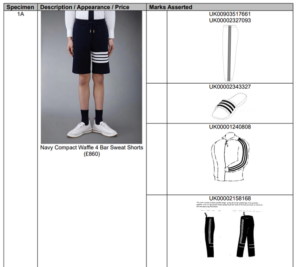
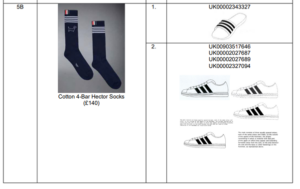
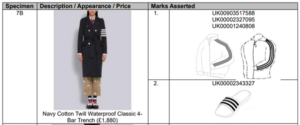
The court has found in favour of Thom Brown and invalidated eight of Adidas’ registrations on the basis that they failed to satisfy the absolute grounds of clarity and precision. The remaining registrations were partially revoked to limit their specifications. In a further blow for Adidas, the court dismissed the counterclaims of infringement and passing off.
“…my own common sense and experience tells me that the average, reasonably observant, consumer paying a moderate degree of attention will generally perceive the difference between three stripes and four. If he or she were to be given six seconds (as Adidas suggests), then I have no doubt that he or she would have no difficulty whatever in perceiving that difference.”
The court found that at least some of the Adidas marks had a high level distinctiveness, distinguishing them from numerous different permutations of stripes on the high street but this may be of cold comfort to Adidas, considering that despite this its counterclaims failed (also see ‘the trouble with position marks’).
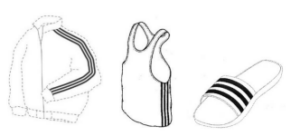
The assessment of confusion was limited to post-sale confusion and involved a detailed commentary. It was noted that there was no real evidence of actual confusion; by the end Adidas was left with only 11 social media posts from Thom Browne’s Instagram (out of a sample of about 2,500) which referenced Adidas and most of these posts were deemed by the court to be either unhelpful or contrary to Adidas’ claims of confusion .
In applying the global assessment of infringement, Smith accepted that Adidas did have a reputation, but that the ubiquitous use of stripes on clothing meant that the use of stripes by Adidas was not unique even if it was distinctive for at least some of Adidas’ products. Adidas was deemed to be a mass market brand, and even with some higher priced collaborations, an average consumer would be surprised at the idea that products at the Thom Brown price point would have an association with Adidas. There was no real likelihood of confusion between the marks or of the marks being linked. There was no injury – the decision references the unusual situation of the alleged infringer being an exclusive brand that would have “no desire to invoke an image associated with adidas, a much lower priced and less exclusive brand, albeit a mass market one.”. Adidas’ arguments included claims that the expansion of Thom Browne products in the sportswear mark would weaken and/or erode the attractive power of the Three-Stripe and that other fashion brands would not want to work with Adidas because the Three-Stripe would no longer solely denoted Adidas. These were dismissed as very speculative.
Adidas’ passing off counterclaim also failed on broadly the same reasoning as for the infringement case. And just when things could not get worse for Adidas, when considering honest concurrent use, the judgment comments that “if either side is responsible for seeking to encroach on the territory of the other, it would appear to be adidas, with its development and launch of the Neuclassics Range in 2022.”.
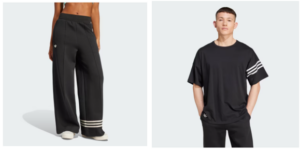
Images taken from “Neuclassics” products available on www.adidas.co.uk
Conclusions
What next for the parties
The decision is a further win for Thom Browne, following successful decisions in other jurisdictions. It will be interesting to see whether Adidas continue to push further infringement claims in other jurisdictions.
The aggressive enforcement strategy of Adidas comes at costs and possibly risk. As the Neuclassics example shows, in seeking to perhaps improve its position in future actions against Thom Browne, Adidas may run the risk of overshooting the mark. Perhaps the future may hold a reversal of roles for these two parties!
Stripe marks
Whilst Adidas has not been successful against Thom Browne, the publicity of the various decisions may still act as a strong deterrent to other third parties looking to use stripes.
The court acknowledged the distinctiveness of the Three-Stipes and the reputation in the mark. But at the same time, recognised that the [UK] high street is full of permutations of stripes.
Adidas’ rights in the Stripe-Mark may be strong but not broad enough to dissuade third parties from using stipes in their apparel.
The trouble with position marks
The judgment highlights some of the limitations of position mark and in particular:
- the difficulty of accurately describing such marks to protect against future invalidation actions;
- the unusual requirement to take into account the physical context and position of the marks when comparing the goods as evidenced by findings of dissimilarity between items of clothing and the Adidas’ marks for shoes and slides.
Parties with position marks should assess how practical the enforcement of such marks is in real terms.
Unchecked co-existence
The decision is also a further cautionary tale regarding co-existence, territories and product expansion. Originally, Adidas had issues with Thom Browne using three stripes, but the addition of a fourth stripe appeared to allay their concerns, until the popularity of the Thom Browne brand grew. By then, over 10 years since the initial dispute, discussions around an amicable resolution stalled, resulting in the US infringement proceedings.
Companies should be very careful on what is/is not allowed by third parties potentially infringing their products, and consideration given to “what happens if….”. A co-existence agreement agreed at a much earlier stage, with clear parameters on acceptable use/registration could have avoided a lot of expense for both parties.
This article was written by Trade Mark Director Apostolos Dakanalis