
























Published March 2023
Spotting innovation in digital health – and can you patent it?
Intellectual Property (IP) can add significant value to your business, providing a competitive edge over the market, as well as demonstrating sound business planning to help secure investment.
There are different forms of IP for protecting different types of innovation.
Patents can be a powerful asset to protect inventions which perform a new function, or cause something to work in a new way.
The requirements for patentability can be perceived as difficult to navigate, which can easily lead to lost opportunities for innovators.
Digital health disruption
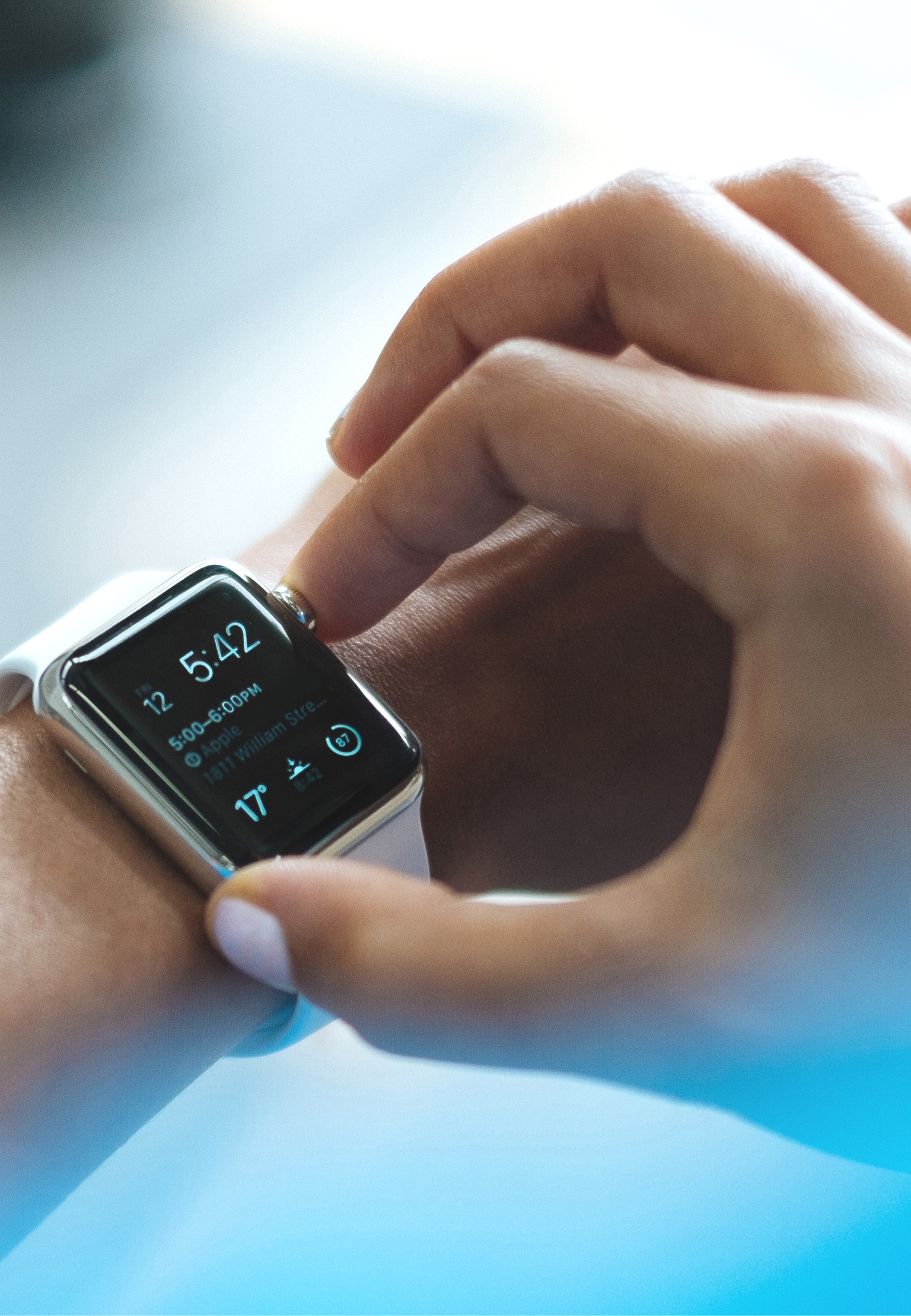
The rapidly evolving field of digital health is disrupting traditional healthcare. Software-controlled wearables and medical devices are used to provide healthcare.
Increasingly personalised care is provided digitally, supported by data driven innovation.
Smartphones are being re-purposed for self-monitoring and self-care, amongst other applications such as communication with healthcare professionals, recording health data, and providing clinical indications.
AI is fast becoming an all-pervasive technology, including in digital health, with applications in healthcare chatbots, diagnosis, directing care, medical image enhancement, clinical data interpretation, and more.
The future of healthcare looks firmly digital.
What’s the problem?
Digital health lies at a unique crossover of disciplines, between medicine, pharmaceuticals, IT, and devices.
Digital health businesses wanting to protect their innovations can therefore find it difficult to know what exactly can be patented.
Digital health inventions can overlap with two common exclusions to patentability.
Firstly, in many countries, certain medical activities are excluded from patent protection, including methods of treatment of the human or animal body by surgery or therapy, and methods of diagnosis performed on the human or animal body.
Furthermore, computer implemented inventions (CII) which are software per se, or which are not “technical”, such as administration or a business methods, cannot be patent protected in many jurisdictions.
So what can you protect in digital health?
Software and apps which support health, wellbeing and treatment can be patentable because they are more than just software per se, but can provide a real world therapeutic effect for a patient.
If the software operates to provide an effect outside the computer, for example to diagnose a health condition, operate a medical device, process medical images, or support a medical intervention, it may be technical enough to be patentable.
It is worth considering if there are different aspects to protecting your software innovation too.
Perhaps data can be collected from a user’s wearable device and used in an inventive way to provide information on the user’s health.
That data may also be used to train an AI model to identify clinical indications for other patients as well. Both ideas may be eligible for patent protection.
For an AI based invention, both the training phase of the model, and the use of the trained model, may be patentable.
Simply using AI alone is not enough to render something technical.
Starting from a non-technical invention, such as sorting data records (an administrative task), using AI to perform some of the processing is unlikely to be enough to meet technicality requirements.
However, if the AI program does something technical, such as identifying diseases, designing medication, or identifying features in medical images, this may well be patent eligible.
As another example, using a neural network to analyse changes in heart function from an electrocardiograph is patentable, because it immediately provides a clinical picture of patient heart health, and a computing device which is programmed to provide a clinical indication can be patentable.
Apps can be patentable if they provide a technical effect.
This effect may be directly in the function of the app (for example, monitoring a person’s sleep habits and providing clinical guidance to improve sleep quality).
There may also be technical patentable features in the graphical user interface (GUI) of the app itself, such as improving accessibility for disabled users or providing for simpler or more intuitive interaction with the device running the app.
Considering the possible exclusion of medically relevant inventions, while a method of diagnosis or treatment is excluded, the apparatus used to perform the method can be patented, and the software operating on the apparatus to provide the functionality may also be patentable.
There is no outright exclusion to the field of medical engineering, provision of healthcare advice, or providing a device which performs a medical procedure.
Key considerations for digital health filings
Software focused patent disclosures benefit from including specific and detailed descriptions of particular implementations of the software used, to help demonstrate technical character, sufficiency, and an inventive step.
Similarly, tying software outputs to a credible technical parameter, plausible health interaction, or physiological state, is more likely to support the presence of a technical effect than output which is a vague “recommendation” or “indication”.
Careful drafting is of great benefit in patent applications for digital health inventions to provide the best grounding to argue for technical character and an inventive step.
For digital innovation in healthcare specifically, simply being related to a medical or healthcare field does not mean exclusion from patentability.
In short, it may be easy to dismiss developments in digital health as not being patent eligible, or being difficult to patent.
However, given the explosion of activity in this field, and the importance of demonstrating your exclusivity in the market, it is worth spending time looking at your digital health innovations from different angles – is it an electronic device, software, an app, AI powered, data driven – and asking, can I patent this?
This article was written by Patent Director, Dr Janine Swarbrick, for HealthTech World. Read the original article here.