


























Articles
Opposition case studies
May 2020
With an increasing number of European patents being granted year on year, freedom to operate for third parties has never been so important. When a patent application is filed at the European Patent Office (EPO), upon grant it becomes a bundle of national patents and subject to national patent laws. For third parties looking to clear the way, this can prove very complicated. Different countries may have differences in national laws and invalidation procedures which may lead to different outcomes.
The EPO offers an efficient and cost effective post grant opposition procedure, whereby within nine months of grant a third party can centrally challenge the European patent. If successful, the patent is then revoked (or amended) across all countries in which it is in force. Oppositions can therefore avoid the potential inconsistency of challenging patents nationally and at a fraction of the price. The official fee for filing an EPO opposition is currently 815 EUR, with attorney fees typically in the tens of thousands of EUR, as opposed to hundreds of thousands or even millions for national litigation.
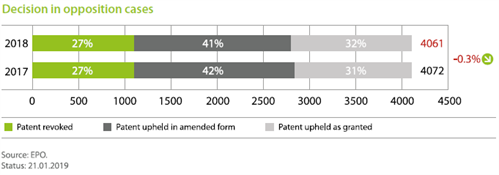
The statistics on opposition outcomes at the EPO are also generally favourable to the challenger, with just over two thirds of patents opposed either being revoked or amended.
A further advantage of the system is that there is no litigation estoppel. Oppositions can also be filed in the name of a strawman, which is potentially commercially significant. For example the European patent attorney filing the opposition or even another company, to conceal the true identity of the opponent.
Early Certainty From EPO Oppositions
Oppositions at the EPO have a very well-established procedure.
- Response – After the opposition nine-month filing window ends, a deadline is then set for the patentee to file a response to any oppositions filed.
- Summons to Oral Proceedings – This includes a non-binding preliminary opinion of the Opposition Division (a panel of three EPO members). This sets a deadline for patentee and opponent(s) to file final written submissions. Typically this might include the patentee filing substitute claim sets (Auxiliary claim sets).
- Hearing – The Summons also sets the date for an oral hearing for all parties to attend at the EPO in the Hague, Munich or Berlin. It is at this hearing all parties have a final opportunity to plead their case with a decision being announced by the Opposition Division at the end of the hearing. The outcome, which is effective the same day, is either:
– the patent is revoked; or
– the opposition is rejected; or
– the patent is maintained in an amended form, for example on the basis of a substitute claim set. - Written Decision – This is then issued within a few months of the hearing, including minutes from the oral hearing.
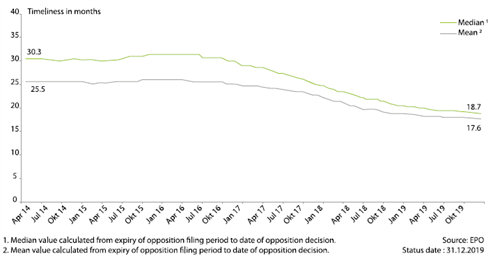
Following feedback from users of the system, in July 2016 the EPO introduced a streamlined procedure aiming to cut the overall duration of ”straightforward” cases to 15 months from expiry of the opposition filing period (i.e. within two years of grant). This does not involve removing any of the above mentioned steps, but instead the EPO optimising its internal workflows. The mean average duration of opposition proceedings as recently reported for 2019 is just over 18 months.
Opposition timelines
Appeals and Rule Changes
Within two months of the opposition written decision being issued, any party adversely affected can appeal. Procedurally, an appeal follows a similar route to oppositions. It typically culminates in an oral hearing held at the EPO Board of Appeal premises in Haar, Germany. The statistics show that appeals are also relatively successful with half or even more opposition decisions being altered as a result.
Appeal proceedings, however, on average have a longer duration compared to oppositions – almost twice the length. In order to address this and provide more consistency, the Rules of the Boards of Appeal were updated effective 1 January 2020. As well as introducing a number of procedural efficiencies, the changes relate to restricting the appeal to the contents of the opposition. This makes it more difficult to introduce new arguments or documents which were not part of the opposition proceedings.
Conclusion
The EPO opposition procedure is undoubtedly a hugely valuable tool for third parties seeking freedom to operate within Europe. Cost-effective, consistent and time-efficient. In the light of oppositions speeding up and the recent change to the appeal rules, challengers should aim to put their best case forward from the outset.
This article was prepared by HGF Partners Leythem Wall and Mike Nelson. If you would like further advice on this or any other matter, please contact Leythem or Mike. Alternatively, you can contact your usual HGF representative or visit our Contact page to get in touch with your nearest HGF office.