


























Christian Louboutin for anyone who doesn’t know, is a French designer of luxury footwear and handbags, whose best-known goods are high-heeled (often very!) women’s shoes. From the mid-1990s onwards, he has added to the shoes an outer sole in a red colour which is a specific pantone shade. The shoes are worn by celebrities and were a favourite of Carrie in Sex and The City. The colour, applied to the sole of a high-heeled shoe, is registered as a Benelux trade mark as of 2005 and the EU since 2016 (filed in 2010, so it took a while!).
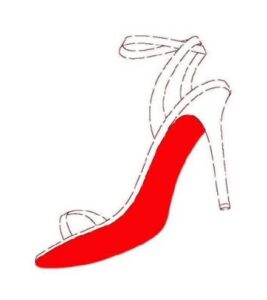
The above image is the EU registration image for high-heeled shoes in Class 25.
In December 2022, the Court of Justice of the European Union (CJEU) held that, retailing giant Amazon could be held liable in relation to advertisements on its online platform selling ‘fake’ Christian Louboutin branded shoes. I have dug a little more into the case below and the background to the dispute.
The original proceedings were brought by Christian Louboutin against Amazon (in the Brussels Companies Court and District Court Luxembourg) concerning the alleged use, without his consent, of signs which are identical to the EU trade mark of which Mr Louboutin owns, by Amazon for goods which are identical with those for which that trade mark is registered. The sales platform run by Amazon for third-party sellers, was according to Mr Louboutin regularly displaying advertisements for red-soled shoes which related to goods which had been placed on the market without the consent of Louboutin. So essentially fake, red-soled shoes were being sold by third party vendors on the Amazon platform.
“According to Mr Louboutin, such use is attributable to Amazon, in so far as that company has played an active role in the use of the signs at issue and the advertisements relating to the infringing goods formed part of its own commercial communication. Amazon cannot, therefore, be regarded as a mere website host or a neutral intermediary since it provides assistance to third-party sellers, in particular how best to present their offers”.
Not surprisingly, the Benelux and Luxembourg courts thought the issues raised were significant and complex. The referring courts essentially asked the CJEU to advise on the below three questions:
- In what circumstances the use of an infringing sign in a commercial offer from a third-party seller maybe attributed to the operator of an online sales website incorporating an online marketplace
- In what circumstances the perception of the public in relation to that offer must be taken into account in order to determine the attributability of such use
- In what circumstances the fact that Amazon ships goods bearing a sign which is identical with a trade mark constitutes, in itself, use of that trade mark, which may be attributed to that company.

The kick back from Amazon was to challenge whether the use of the trade mark can be attributed to them. Amazon made several points, in short:
- Amazon referred to other online marketplace operators such as eBay – they maintained that the operating method of the marketplaces incorporated into its online sales websites is not significantly different from that of other marketplaces – just because their Amazon logo was present does not mean that it adopts those advertisements.
- The ancillary services it offers to third party sellers cannot justify their offerings being regarded as forming part of its own commercial communication;
- The fact that a service provider creates the technical conditions necessary for the use of a sign which is identical with a protected trade mark and is remunerated for that service does not mean that the service provider itself makes use of the sign at issue.
Thus, Amazon doesn’t think that simply because they make money from an advertisements would mean they are liable. As said also, Amazon isn’t the only company to have adopted a hybrid business model.
The CJEU was of the view that the public perception in a case such as this may be significant. It is also to be noted that the Advocate General (AG) gave an opinion in June 2022 which looked into prior decisions such as Google France, Loreal, and Coty Germany which all found no direct liability on the part of online intermediaries for trade mark infringement. The AG opinion in a nutshell was:
“online intermediary cannot be held directly liable for infringements of the rights of trade mark owners taking place on its platform as a result of commercial offerings by third parties”.
Ultimately, the CJEU didn’t agree with the AG opinion. They discussed issues surrounding what constitutes “using”, how advertisements are presented and the well-informed and reasonably observant user. The end-user played a pivotal role in the deliberations.
The CJEU ultimately held:
“the operator of an online sales website incorporating, as well as that operators own sales offerings, an online marketplace maybe regarded as itself using a sign which is identical with an EU trade mark…where third party sellers offer for sale, on that marketplace, without the consent of the proprietor of the trade mark…if a well-informed and observant user of that site establishes a link between the services of that operator and the sign at issue”.
The real key element is the reference to the end user and several factors were cited where a link could potentially be present:
- The operator uses a uniform method of presenting the offers on the platform – it becomes hard to tell which products are being sold by a third party and those by the marketplace operator;
- Displaying the operator’s own renowned logo on the advertisements;
- Offers additional services, aside from the general marketing of goods, to a third-party seller such as storage and shipping of goods.
The CJEU guidance has been sent back to the courts in Belgium and Luxembourg to consider whether consumers would in fact make such a connection and they will render final judgement.
The takeaway for retailers is to consider the use of a hybrid working model for selling goods, as it can potentially leave operators liable for the sale of counterfeit goods. Clearly, also retailers in general have deeper pockets than single entities selling goods and indeed counterfeiters are often impossible to track down. Retailers with platforms like Amazon may wish to consider where their house logo appears or other sub brands and perhaps to try and distinguish further from third parties. It will certainly be interesting to see if Amazon is found liable, as this would change the current legal landscape on this issue.
This article was prepared by HGF Partner & Trade Mark Attorney Rebecca Field.