




















Published Oktober 2026
A cool new IP opportunity in data centre design – can you patent intelligent cooling?

How AI-controlled cooling and digital twins create new IP opportunities and value for data centre innovators.
Data centre cooling innovation on the rise
The rapid growth in data centres, increasingly for AI processing, is creating challenges. Data centre cooling is fast becoming a fundamental technological consideration, and data centre AI workloads, with often enormous and increasingly variable heat generation, can add strain to heat, power, and cooling infrastructure. With the developments in cooling control, a significant area of patent activity may develop.
Thermal management and cooling is already one of the most active areas of data-centre patenting. Taiwan’s Intellectual Property Office (TIPO) identified 8,449 global patent families relating to data-centre and server cooling technologies published between 2015 and 2024. The sector recorded a 17% CAGR over the decade, with annual filings exceeding 1,000 from 2022 onwards[1],[2]. This level of patent filing suggests competitive activity in AI infrastructure technologies overall.
Further, of the top 20 applicants identified by TIPO, eight are US companies, six are from mainland China and three are Taiwanese. The US group includes NVIDIA, Alphabet, Microsoft and Amazon, with a technical focus on AI control, neural-network optimisation, direct-to-chip and microfluidic cooling. Chinese applicants include Inspur, Baidu, Huawei and State Grid with applications directed to large-scale infrastructure monitoring and predictive control. Taiwanese applicants Inventec, Foxconn and Quanta are filing for innovations in hardware integration, liquid cooling and immersion systems.
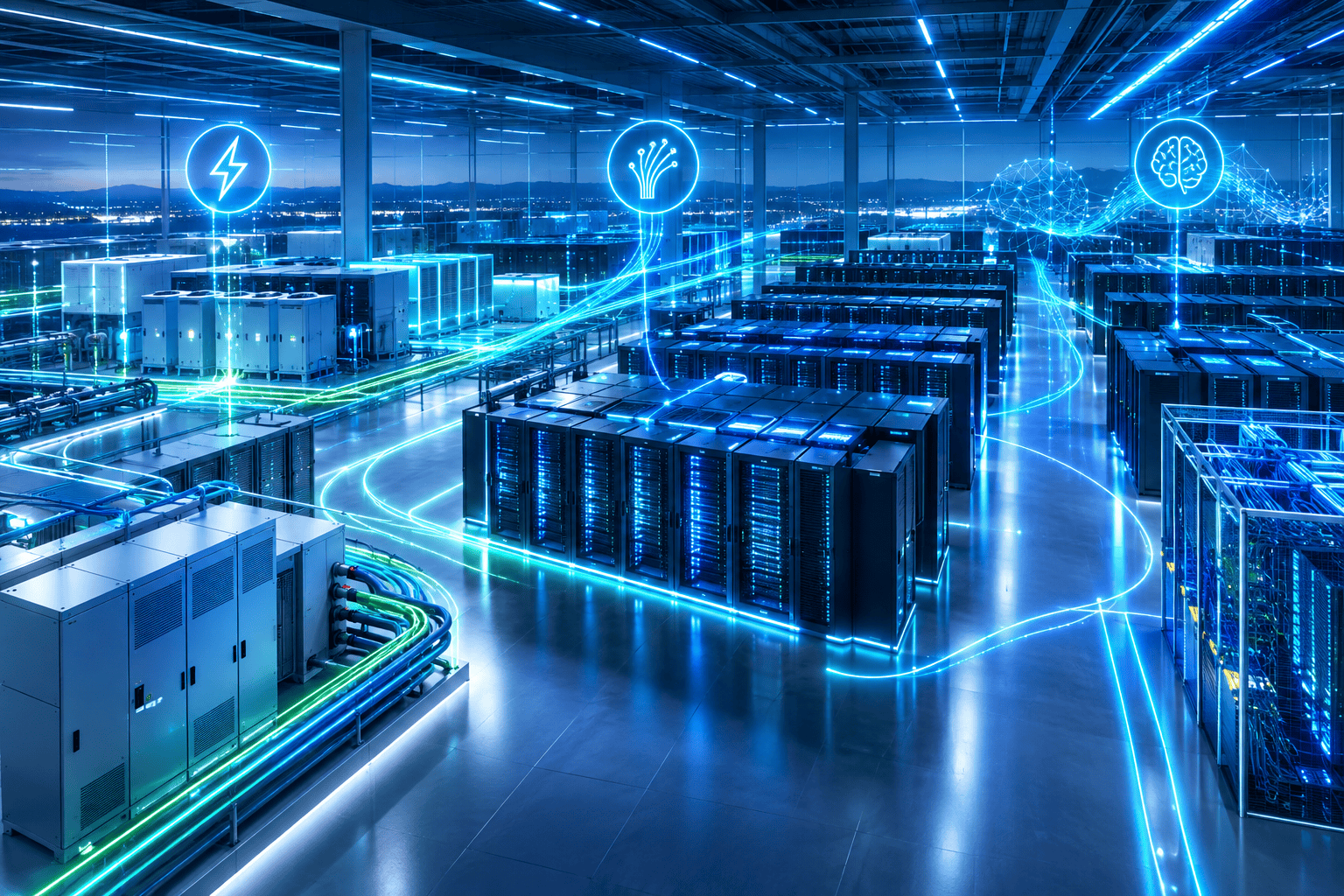
The filings show that cooling technology is evolving from air cooling, towards direct-to-chip liquid cooling and immersion. Increasingly, AI-driven control, digital twins and reinforcement learning are being used to control cooling requirements in data centres.
Intelligent cooling control
New innovations in data centre cooling technology are not tied to the hardware, and emerging ways of smart cooling control using software solutions are being developed to manage the variable and sometimes large cooling requirements of modern data centres.
A digital twin (a computer model of the real-world system) can be used to simulate different thermal conditions and cooling strategies of a data centre cooling system virtually before changes are made to a real-world facility[3]. Such a model may be able to simulate air, liquid or immersion cooling scenarios. The results can inform an appropriate operating strategy, possibly in near real-time, for cooling optimisation processes to be determined and deployed.
Machine learning control can be used to control cooling[4], by dynamically adjusting fan speeds, airflow or liquid-cooling parameters according to real-time thermal conditions. Such control may involve workload-predictive management, which can anticipate a thermal event before a high-compute workload runs, allowing pumps, chillers or other cooling resources to be adjusted proactively.
These software-focussed solutions to data centre cooling involve significant innovation, and so the question arises: can these software approaches be patented?
IP in software-enabled data centre cooling
Potentially these innovations are patent protectable, but the scope of protection for an AI-powered cooling model is unlikely to simply be “an AI model for cooling.”
Under European patent principles, AI and mathematical models are not excluded from patent protection if they provide a technical contribution by solving a technical problem. AI and machine-learning techniques can contribute to the technical character of an invention when they form part of a technical solution. Thus, an AI-enabled cooling system may be claimed by defining the AI as a part of the wider cooling control system. For example, including technical inputs such as data received from temperature sensors, or data indicative of data processing requirements by the data centre, can support a technical invention. Further, outputs with a technical purpose such as providing a control signal to cooling hardware also support arguments that there is a technical overall system.
Without claim features tying the AI model to the real world and providing a technical effect, the claim risks being considered to be a mathematical method or computer program as such as therefore being excluded from patentability. An AI model that merely predicts temperature may face a more challenging prosecution at the EPO than an AI model which predicts temperature and controls a cooling system in dependence on the predicted temperature.
What could potentially be patented?
Several areas may offer opportunities for patent protection, subject to the usual requirements of novelty, inventive step and sufficiency of disclosure. For example:
Predictive thermal control: where a control system uses workload and sensor data to predict future thermal conditions and proactively adjust cooling equipment before a thermal constraint is reached.
Digital-twin-controlled cooling: a system that uses a digital twin to simulate alternative thermal states or cooling strategies and then applies the selected control strategy to a physical cooling circuit.
Workload-to-cooling optimisation: a physical control architecture that links AI workload scheduling, data centre processor use or predicted compute demand to the allocation of cooling resources and controlling those cooling resources.
Physics-constrained AI control: a machine-learning control system in which predictions or control decisions are constrained by thermal, fluid-dynamic or other physical parameters to improve cooling stability, efficiency or performance.
It is worth noting also that if the innovation in an AI powered system really lies in the details of the ML model to perform temperature control in a particular way (as opposed to use of a machine learning model in a new way), the EPO will expect details of the ML model to be clear in the description, such as characteristics of the training data, architecture and parameters of the ML model, and the nature of the inputs and outputs. A “black box” type claim simply reciting that machine learning is involved will be unlikely to reach the criteria for patentability if it is the details of the ML model which provide the technical effect and solve a problem.
Where might the patent whitespace be?
Data centre cooling technology has been developing for some time, and patent activity in thermal management is already substantial and increasingly competitive in the new era of large data centres for AI processing.
A more interesting opportunity may therefore lie not in an entirely new cooling technology, but in the combination of established technologies with intelligent control.
For example, a digital twin that is used not merely for simulation but to generate control inputs for pumps and valves in a new way may be novel and inventive. An AI controller that translates predicted workload demand into physical cooling adjustments and signals how to operate to a cooling system may also be patentable. Ensuring there are sufficient details of how such approaches are new and inventive over what is known in the art are critical to demonstrating there is a patentable invention.
For technology companies investing heavily in AI data centres, identifying and protecting the connection between AI or software cooling requirement determination and physical thermal infrastructure may be as important as protecting other aspects of the cooling, such as the cooling hardware.
Why it matters now
AI infrastructure is being deployed at extraordinary scale, increasing pressure on power, cooling and operating efficiency. U.S. data-centre construction spending reached an annualised rate of more than $75 billion in July 2026, nearly 60% higher than in July 2025, according to U.S. Census Bureau data[5].
Meanwhile, AI-related patent activity continues to grow: the EPO reported a 9.5% increase in AI patent applications in 2025, alongside a 6.1% increase in computer technology applications[6].
As AI workloads continue to drive up the power and thermal demands of data centres, the technology used to manage and cool that infrastructure is becoming increasingly important in its own right. For companies, the opportunity to protect innovative cooling methods may provide valuable IP protection in this increasingly important technology area by carefully navigating the patentability criteria in Europe for software and AI developments. Companies should treat intelligent cooling control as a strategic IP asset, not merely an operational efficiency tool.
[1] https://www.tipo.gov.tw/tw/tipo1/106-68869.html
[2] https://www.inventec.com/en/news-detail111.htm
[3] https://link.springer.com/chapter/10.1007/978-3-032-09040-9_8
[4] https://engineering.fb.com/2024/09/10/data-center-engineering/simulator-based-reinforcement-learning-for-data-center-cooling-optimization/?utm_source=chatgpt.com
[5] https://finance.yahoo.com/technology/ai/articles/ai-data-center-construction-spending-204543407.html
[6] https://www.epo.org/en/news-events/news/demand-european-patents-2025-exceeded-200-000-first-time
This article was prepared by Partner and Patent Attorney Janine Swarbrick.