

























Articles
Protecting inventions in Europe and beyond
February 2025
A patent is a form of registered intellectual property right granted for new, inventive and industrially applicable inventions. Patents are monopoly rights that allow their owners (or licensees) the right to work an invention while the patent is in force. Securing patent protection for an invention has many advantages for businesses, for example, assisting in obtaining investment, establishing or maintaining a leading position in the market or providing a source of revenue from licensing royalties.
Patents are jurisdictional. As such, patent protection has to be obtained in each country of interest and this can incur significant costs. One commonly used patent filing strategy to spread out and defer such costs is shown below, and this makes use of the Patent Co-operation Treaty (PCT) application process.
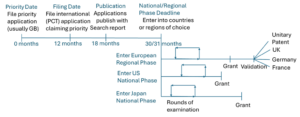
In this example, the applicant files their initial patent application – the priority application. For most UK based companies, it makes sense to file this application at the UK Intellectual Property Office (UKIPO) because of the relatively inexpensive official fees. It is also possible to obtain a quality search from the UK within about 6 months from the initial filing date. The search report can provide information about the state of the art and allow an informed decision on the future investment in the patent application.
Within twelve months from the filing date of the priority application – the priority year – the applicant can file subsequent patent applications directed to the same invention as that disclosed in the priority application and “claim priority” .This means that the novelty and inventiveness of the subsequent applications are examined against any known disclosure (prior art) before the priority date.
Applicants tend to seek patent protection in countries where they manufacture, sell, import or have potential licensees. If the applicant were to file patent applications in each of these countries at the 12 month stage, this could require significant expenditure. Therefore, instead the applicant can chose to file what is known as an international application (PCT). This essentially creates a pending patent application which has the potential to be taken further forward in 158 countries. The applicant then has a further 18 months from the filing date of the PCT application to determine which countries of interest they wish to pursue obtaining patent protection. During this time, a further search report will be issued and the application will be published. Publication of the PCT application occurs at around 18 months from the priority date and in some instances can establish provisional patent protection.
In the example, at 30/31 months from the priority date, the applicant has chosen to pursue patent protection in the US, Japan and Europe. By entering the PCT application into the European patent office, the applicant now has a pending European application which can cover 39 countries. If the European patent application is granted, the applicant can choose which of these countries they wish to have a granted patent in by validating the patent in those countries. The option now also exists to obtain an Unitary Patent that covers 18 countries in the EU via a single patent. In the example above, the applicant would validate as a Unitary Patent and in the UK, or alternatively in the UK, France and Germany. The applicant also has a pending US and a pending Japanese patent application. Each of these applications will subsequently be examined by the patent office in these jurisdictions and could go on to form granted US and JP patents.
This article was written by Patent Director Clara Orofino