





















Plant-e Knowledge BV & anor v Arkyne Technologies SL UPC_CFI_239/2023 (Brinkman, Granata, Walker & Koke) – 22 November 2024
The Hague Local Division has handed down the first substantive UPC judgment applying the doctrine of equivalents. The Hague LD found that Plant-e’s European Patent No. 2137782 was valid and infringed by equivalence. Where there was no literal infringement of the claims, the Hague LD considered infringement by equivalence.
In assessing whether the variant is equivalent, the Hague LD considered the following questions. First, does the variation solve essentially the same problem and perform essentially the same function as the patented invention (i.e., technical equivalence)? Second, would extending the scope of protection of the claim to cover the equivalent be proportionate and fair for the patentee? Third, would the skilled person understand from the patent that the scope of the invention is broader than what is claimed literally? Fourth, is the allegedly infringing product novel and inventive over the prior art?
Background
The Patent entitled “Device and Method for Converting Light Energy into Electrical Light” was in force in the Netherlands, Belgium, Luxembourg, Germany, France and Italy. The invention related to a device and method for converting light energy into electrical energy and/or hydrogen by using a living plant for converting light energy into electrical energy and/or hydrogen.
The Patent claimed a Plant-based-Microbial Fuel Cell (“P-MFC”). An MFC generally comprises a reactor, and the reactor comprises an anode compartment and a cathode compartment. The P-MFC introduced a living plant in the ‘reactor’ that converted (sun)light into nutrients (organic material) by photosynthesis. The photosynthesis process releases organic compounds into the soil, feeding anodophilic microorganisms surrounding the plant. When the microorganisms metabolise the compounds, they transfer electrons into their surrounding environment, which are collected and utilised by the anode. Electrons then travel to the cathode, ultimately creating an electric current.
Plant-e was a Dutch start up spun out of Wageningen University. It developed three products: a small biofuel cell for educational purposes, a biofuel cell for use with a sensor (particularly for use in agriculture) and a biofuel cell with lighting that can be installed in the ground for use in gardens and parks.
Arkyne (a Spanish startup referred to as Bioo in the Decision) offered for sale and sold a small biofuel cell for educational purposes (the ‘Bioo Ed’), a small biofuel cell for use with a sensor (the ‘Bioo Sensor’), a large biofuel cell with lighting that can be buried in the ground for use in gardens and parks (the ‘Bioo Panel’), and a ‘Bioo Bench’ which incorporated three Bioo Panels.
| Plant-e Product (Fig.1 of Patent) | Bioo Panel |
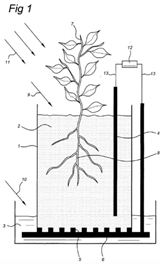 |
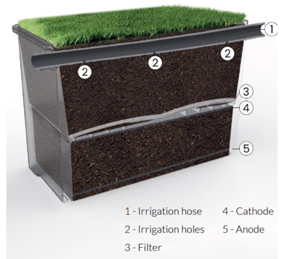 |
UPC_CFI_239/2023 (Pages 2 and 14)
Plant-e brought infringement proceedings seeking various remedies, including an injunction, an infringement declaration, and destruction of the Bioo infringing products. Bioo counterclaimed for revocation of the Patent, and argued it was invalid for added matter, and that it lacked novelty, inventive step and sufficient disclosure.
Judgment
Literal infringement
The focus of the infringement case was independent method claim 11, divided into the following integers:
11.1 Method for converting light energy into electrical energy and/or hydrogen
11.2 wherein a feedstock is introduced into a device that comprises a reactor
11.3 where the reactor comprises an anode compartment (2) and a cathode compartment
11.4 and wherein the anode compartment comprises a) an anodophilic microorganism capable of oxidizing an electron donor compound
11.5 and b) a living plant (7) or part thereof, capable of converting light energy by means of photosynthesis into the electron donor compound
11.6 wherein the microorganism lives around the root (8) zone of the plant or part thereof.
As can be seen from the Figure above, the Bioo Panel differed from the claimed invention, as it included two compartments (rather than one) wherein the upper compartment contained the plant and its roots and the lower compartment contained the anode and microorganisms.
The Court held that the Bioo Panel literally applied all features of the claim except for the location of the plant and its roots (together with the microorganisms) in the anode department. Integer 11.6 was not completely fulfilled in the Bioo Panel, as it could not be established that the roots of the plant were in the anode compartment where anodophilic micro-organisms (mainly) live, as the Bioo Panel separated the plant, roots and microorganisms from the anode compartment.
In light of the above, the Hague LD held that there was no literal infringement of claim 11.
Infringement by equivalence
The UPCA did not provide expressly for a doctrine of equivalents, however, the Hague LD considered that Art. 2 of the Protocol to Art 69 EPC makes clear that equivalence must be considered when assessing the scope of protection.
As set out above, the Hague LD set out a four step test, where each question must be answered in the affirmative to establish infringement by equivalence. In this action, the Hague LD answered all four questions in the affirmative for the following reasons:
- Technical equivalence: The Bioo Panel was designed to achieve the same outcome as claim 11 – it created an MFC independent of externally furnished fuel by introducing a living plant into a system as a constant supplier of organic material to the reactor, creating a P-MFC.
- Fair protection for the patentee: The patent claimed a new category of MFCs by introducing a plant into the device/reactor and to obtain electricity from organic material originating from the photosynthesis by that plant and thus from light energy. The Court opined that because it was a new category of MFC, and that Plant-e’s invention was given its own name (P-MFC), “a fairly broad scope of protection is therefore in line with the contribution to the art”. The Court held that the plant in the Bioo Panel had the same function as in the claim, solved the same problem, and did so in a similar way to the claimed invention. The minor differences (i.e. the extra compartment and location of the roots/microorganisms) did not affect the function of the plant and was therefore deemed to be equivalent.
- Legal certainty for third parties: Interestingly, the Court held that this requirement is met “if the skilled person[1] understands that the patent claim leaves room for equivalents because the teaching of the patent is (clearly) broader than the wording of the claim” and there is no good reason to limit the scope of protection.
- Bioo Panel inventive and novel (‘reverse Gillette/Formstein defence’): the parties agreed that the Bioo Panel would have been novel and inventive over the prior art at the priority date.
Therefore, the Hague LD held that the Bioo Panel infringed (by equivalence) claim 11 of the Patent.
Conclusion
As the first substantive judgment applying a doctrine of equivalents, this is an important step for the UPC. The Hague LD has set out a proposed test for considering equivalents which is similar to the Dutch patents court’s approach. As this is an area of divergence in the application of the EPC as between the national patents courts, parties will be watching this development keenly. It is not a given that other UPC Divisions will adopt the same approach of The Hague LD, or if the Court of Appeal will agree or adopt a different test.
Arkyne/Bioo had not filed an appeal to the UPC Court of Appeal before the deadline. Therefore, a LD test for the doctrine of equivalents remains the only guidance we have on how the UPC will apply the test.
[1] The Hague LD held that the skilled team for the purposes of the Patent had a scientific background to PhD level in biochemistry, electrochemistry and possibly microbiology or environmental engineering with 3-4 years practical experience of working in the field of MFC.
This article was written by HGF Partner and Head of Law Rachel Fetches and IP Solicitor Sian Hope