
























Blog Posts
Innovating the Future of Healthcare: Patent Filing Trends in Europe
March 2023
The healthcare industry has experienced a significant transformation over the past few years, and this looks to be only the start of a significant re-think of how healthcare is provided, driven by new technologies and digital health innovation.
Digital technology has revolutionized the way healthcare is delivered, from remote patient monitoring and virtual consultations, through AI analysis of medical data and images, personalised healthcare and more, with aims of making healthcare more accessible, efficient, and cost-effective, and reducing the burden on healthcare providers such as the NHS in the UK.
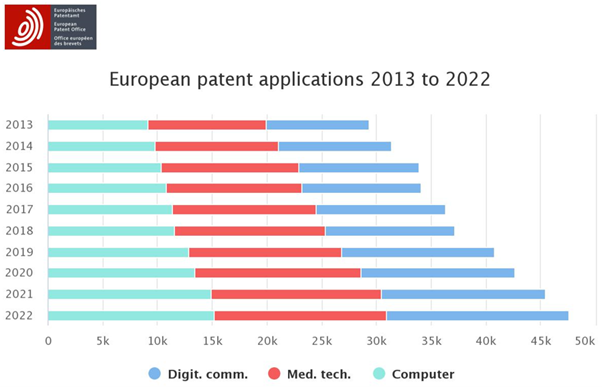
Recent patent filing statistics from the European Patent Office (EPO) demonstrate the extent of the boom in digital health innovation, with a significant increase in the number of patent filings related to digital health.
The number of European patent applications in the field of digital communication has been steadily increasing over the past several years, with a worldwide 11.2% increase in the past year alone, making it the number one filing area. Similarly, medical technology filings have remained in the number two spot for the number of filings with a 1% increase in 2022, with computer technology a close third for number of filings and with a 1.8% increase in filing numbers in 2022.
So, what is driving this growth in digital health innovation? One factor may be the increasing demand for healthcare services, which is putting pressure on healthcare systems to find more efficient ways to deliver care. Digital health technologies, such as telemedicine, remote patient monitoring, and mobile health apps, can help to address this demand by allowing patients to access care from anywhere at any time, and by facilitating more preventive treatments, powered in part by advances in artificial intelligence (AI) and the Internet of Things (IoT) innovation.
AI and IoT are currently undergoing rapid development to provide new, implementable, computing and communications technologies. AI and IoT innovations are being integrated into healthcare systems and aim to facilitate improved diagnosis, indication of potential preventative action to mitigate against future healthcare issues, and improve patient outcomes. For example, AI-powered algorithms can help doctors to diagnose diseases more accurately and quickly, while IoT devices can provide real-time data on patient health and activity and alert healthcare providers to potential issues in various healthcare environments.
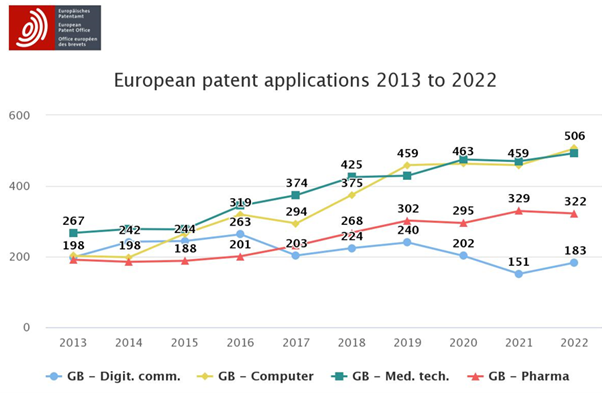
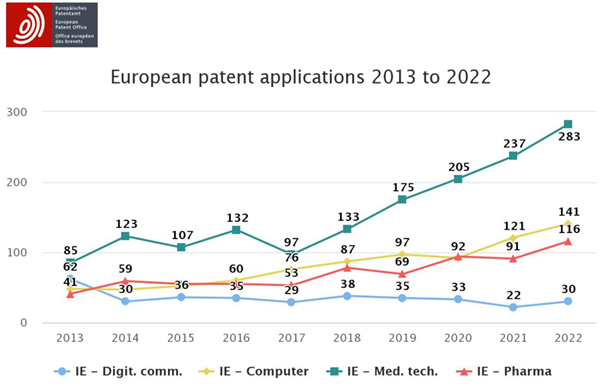
Looking at the filing trends in digital health by country, there are also some interesting patterns. Europe has seen an steady increase in filing numbers in the field of medical technology as well as the USA, China and Korea. Focussing on Europe, medical technology filings have increased in recent years most notably in Switzerland, the UK, and Ireland.
In 2022, the UK saw the highest number of applications being filed in the fields of computing (8.9%) and medical technology (8.7%). Medical technology accounts for around a quarter (24.8%) of all patent applications from Ireland, with 12.4% of filings relating to computer technology and 10.2% to pharmaceuticals.
It will be interesting to see how these trends pan out as emerging digital health technologies start to mature, in particular in the UK and Ireland based on the current trends in European patent filing data, so watch this space!
If you have any questions about patenting in the digital health space, please feel free to get in touch with us and we will find the right person for you to speak to. HGF have a diverse team of attorneys based across Europe, with experts in MedTech and digital health technologies based in the UK and Ireland.
This article was prepared by HGF Patent Director Dr Janine Swarbrick.