
























< Back to latest news & events

Articles

Gender diversity at the UPC

November 2022

In Europe, women remain grossly under-represented in research and innovation. A recent study by the European Patent Office (EPO) found that only 13.2% of inventors in Europe are women.

The Unified Patent Court (UPC) is a new Court that is being set up to decide in particular on the infringement and validity of both new Unitary Patents and classic European Patents; comprising judges from all participating Member States of the European Union.

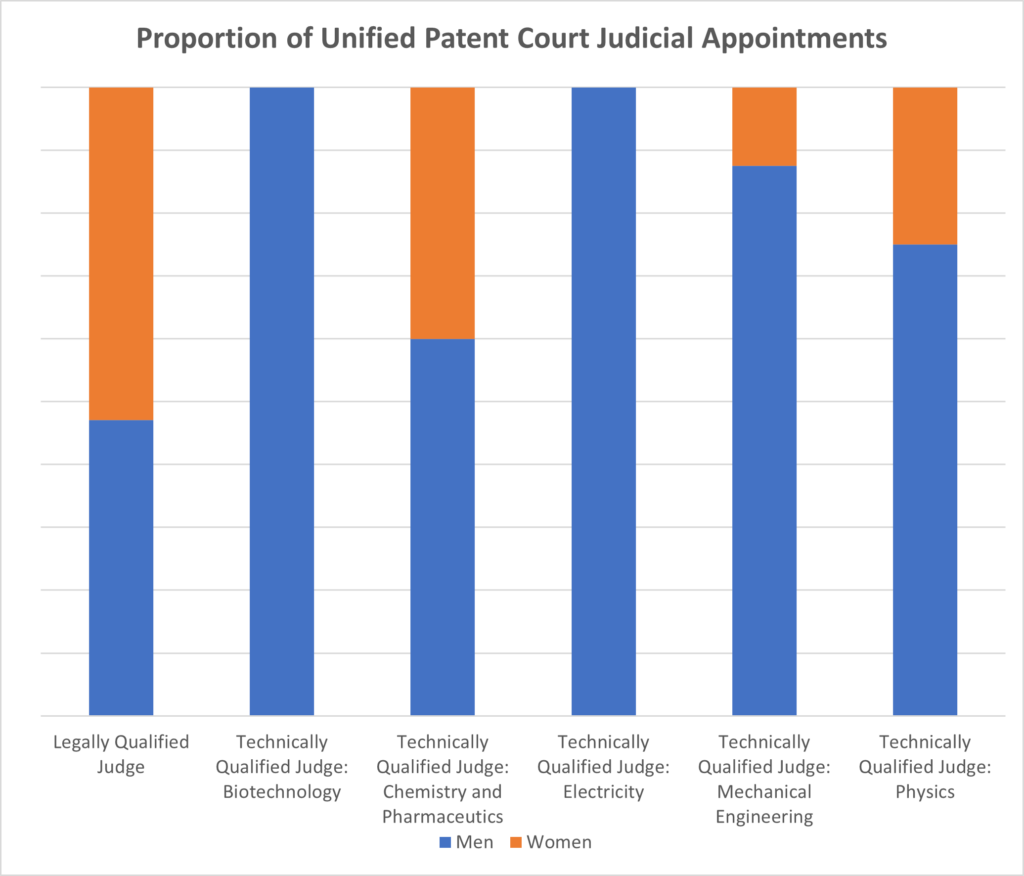
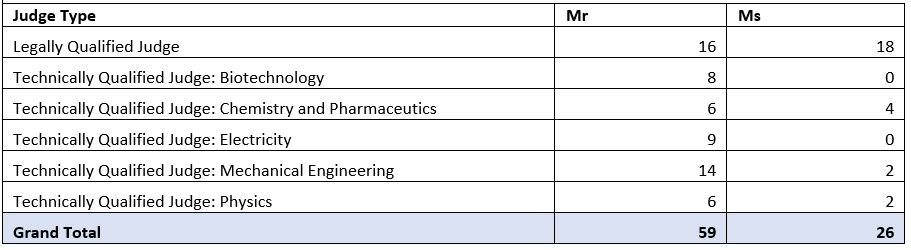
The Unified Patent Court has now confirmed the appointment of a total of 85 judges (34 legally qualified judges and 51 technically qualified judges) to take up their duties as of the entry into force of the UPC Agreement. Looking at the composition of the UPC Judiciary, taking the published prefix of Mr and Ms for each Judge as a proxy for men and women we looked the relative proportions of appointments (see table 1). Women are set to make up slightly more than half (16 Mr : 18 Ms) of the Legally Qualified Judges.

However, this is not true for Technically Qualified Judges.
It is widely reported that the percentage of female STEM graduates is considerably lower than male STEM graduates.

Women in Tech reports that:
Around 15% of engineering graduates are female, 38% for Maths, and 19% for Computer Studies. This gap in STEM education translates in the workplace to men dominating the industry with just 19% being women. Encouraging girls to study STEM subjects with the view of pursuing a career in tech is important not just for the campaign for gender equality in society, but also for the UK’s competitiveness as technology pioneers. It has been estimated that by 2025, the UK will be 1.8 million short of engineers. Levelling the playing field and making a career in tech more appealing and exciting in the eyes of future generations is a way to prevent a skills shortage in the future of the UK tech industry.

Although we do not know what proportion of UPC judicial candidates were women, overall, in the UPC as in STEM, it would appear there is still some way to go for women in their technical fields to reach parity with men.

Table 1

This article was prepared by HGF’s Partner & Patent Attorney Hsu Min Chung.

Latest updates

A New Era for AI Patents in the UK: Supreme Court Aligns with the EPO

The UK Supreme Court has handed down its long-awaited judgment in Emotional Perception AI Limited (EPAI) vs Comptroller General of Patents, a decision which serves to significantly change the way …

Read article
Event - 23rd - 25th March 2026

HGF are Gold Sponsors of IPBC Europe 2026

HGF are proud sponsors of IPBC Europe 2026, taking place from 23-25 March 2026 at the Pullman Paris Montparnasse. Bringing together patent pioneers, in-house leaders and private practice specialists, IPBC …

Event details
Event - 8th - 11th February 2026

AUTM Meeting 2026

We are attending the AUTM Annual Meeting from 8–11 February, a flagship event bringing together technology transfer professionals from across the globe. AUTM connects innovators, universities, and industry leaders to …

Event details

The Antibody Series #5 | Epitope-defined antibody claims: when “binds to this epitope” becomes a risk of insufficiency

The Boards of Appeal of the EPO (BoA) are the appeal body that reviews decisions made at the EPO; here, they reviewed an appeal in opposition proceedings after the revocation …

Read article

The Deity Shoes case: a question of design activity and the constraints on a designer’s freedom

The footwear brand Deity Shoes sought to enforce their Community Design rights, both registered and unregistered, against Mundorama Confort and Stay Design. However, Mundorama Confort and Stay Design found fault …

Read article

The Antibody Series #4 | pH points in antibody claims: when “same pH ” becomes an addition of matter

The Boards of Appeal of the EPO (BoA) are the appeal body that reviews EPO decisions; in this case, they reviewed a revocation in opposition of a patent relating to …

Read article

The Antibody Series #3 | Antibody code names in claims: why “ACZ885” is not sufficient to define the antibody

The Boards of Appeal of the EPO (BoA) are the appeal body that reviews EPO decisions. In this case, they examined a claim that identified an antibody by an internal …

Read article
Event - 3rd February 2026

HGF Brand & Design Conference 2026

Join us on 3rd February 2026 for HGF’s Brand & Design Conference, the must attend event for in-house legal teams, brand leaders, creatives, and innovators shaping the future of IP. …

Event details