


























The use and creation of digital healthcare products is on the rise as companies look to create a unique selling point and a differentiator in a crowded market. One of the many ways that businesses within the healthcare industry can benefit from this, is through the use of trade marks.
What is digital healthcare?
Technological development has taken place through a variety of channels, including, smartphones, social media and software. This has led to the rapid digitalisation of several industries including the healthcare industry. Some sources have reported that the digital health sector will grow 27.9% from 2020 to 2027 and will then be worth $833.44 billion (Precedence Research). Moreover, the WHO is ‘harnessing the power of digital technologies’ through its strategy to implement global digital health initiatives by 2025.
Digitalisation has had a wide-ranging impact, one of the most significant being the greater interaction between medical or health businesses and their end users. There has also been a proliferation in the range of products available to consumers and innovation, leading to the availability of new products.
Some examples of this include wearable technology, such as the Fitbit watch and mobile apps like Sleep Cycle, which assist consumers with monitoring their own health more closely than ever before. The Fitbit watch, for instance, can monitor heart rate, temperature and oxygen levels. The Sleep Cycle app can help to monitor and improve sleep quality – the key is that there is direct engagement between the brand and the consumer over health. In turn this makes healthcare more accessible to all and also creates a crossover between fitness and overall health.
Certain global health developments have also increased the importance of digitalisation. The pandemic is a significant example. Indeed, the NHS app assisted with the tracking of Covid-19 cases and with the vaccine rollout. Symptom checkers were also useful, where limited in-person contact was necessary. The WHO has also stated that it was actively ‘advancing approaches to using digital products to end the current pandemic and prevent future ones’.
General trends in digital healthcare have included:
- Medical software
- Artificial Intelligence
- Telehealth
Brands will continue to create new products and innovations using these and other technologies.
What is a Trade Mark?
A trade mark indicates the trade origin for a good or service and is therefore integral to product branding. It is a badge of trade origin – a unique identifier and a valuable company asset. For example, healthcare companies protect all elements connected with brands:
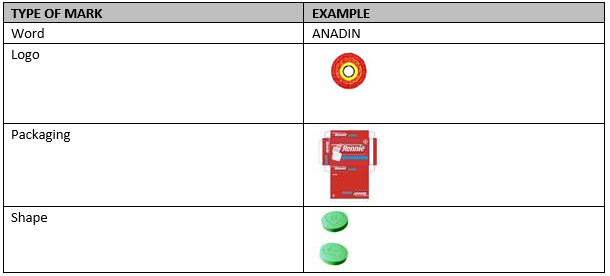
Trade marks play a significant role in branding, advertising and marketing. You may recognise some of the above trade marks and this instant recognition is what protects a company’s investment in branding and product quality, as well as allowing consumers to know with certainty the origin of the products they are purchasing.
New digital health products, such as the Fitbit and Sleep Cycle also have their own trade marks, an example of which is their brand names. Pharmaceutical companies have also been leveraging the new digital healthcare trends to create new products. Glaxosmithkline and Johnson & Johnson are both actively working to create new products implementing artificial intelligence, smart devices and wearable technology to name a few. These new products would likely have names, logos, packaging and even shapes that could give rise to trade mark protection.
If another company were to use your trade mark or a trade mark similar to your own, consumers could think that the third party’s product originate from your own, which would not only be deceptive and harmful to consumers, but could also lead to brand dilution, reputational damage and a third party taking unfair advantage of your brand investment.
When you obtain a trade mark registration, you have an exclusive right to use certain characteristics of a product in relation to certain goods or services. This right can also be obtained where a mark has been used for a sustained period of time, in some cases. Trade mark rights exist within certain countries and territories. As such, trade mark rights should be sought, wherever trade mark protection is required. There is also the option to file an application for an international trade mark registration.
However, it must be noted that not all product characteristics can be given trade mark protection. For example, an inhaler has been rejected for protection due to its performance of a technical function (Glenmark Pharmaceutcials v Boehringer Ingelheim). This is particularly important in the context of medical devices, which often perform a technical function.
Why are Trade Marks beneficial in Digital Healthcare?
Trade Marks are beneficial in relation to digital healthcare specifically due to their value in branding, advertising and marketing. This is particularly important, due to the product innovation leading to new products and associated brands, which will need to be communicated to consumers. Greater contact between health companies and consumers also enhances the importance of branding.
All businesses have trade marks, whether this is done intentionally or not. An awareness of trade mark protection, will allow a company to extract as much value as possible from their trade marks, within the new digital healthcare landscape.
For example, if you would like to expand sales of your digital healthcare product within a particular territory, you may want to consider registering your trade mark within that territory. Additionally, if you are about to launch a particular product, you may want to register its name, logo, packaging or shape, for example, as a trade mark.
Accordingly, the benefits to new digital healthcare products are immense. Utilising trade marks could allow these products to benefit not only in terms of their reputation and consumer perception, but also financially.
Trade Mark protection also plays an important role in regulation, as it will allow consumers to confirm the origin of the products. This is significant, due to the potential impact these products could have on their health.
Practical considerations for business owners and those wishing to obtain trade mark protection in digital health
There are some practical considerations that you may wish to consider:
- Firstly, it is crucial that you try and pick a strong trade mark. As above, some product characteristics are unregistrable. However, some trade marks simply have a greater degree of recognition among consumers, so will do more for your brand as a whole.
- Secondly, you should consider the goods and services for which you would like to register your mark. Each product will fall within a specific class of the international Nice classification system.
- Thirdly, you should consider the territories in which you would like to register your trade mark. This will usually coincide with wherever your business is planning to sell.
- Fourthly, it will be important to monitor use of your trade mark post registration and to monitor other potentially infringing trade marks and take action where necessary. The importance of this is highlighted through Fitbug’s loss of trade mark infringement law suit due to their delay in enforcing their trade mark rights.
Conclusion
Digitalisation is transforming the healthcare industry and creating greater opportunity for innovation, brand creation and development. Trade marks can play a significant role in assisting businesses to maximise the benefits from these new developments.
This article was prepared by HGF Partner & Trade Mark Attorney Rebecca Field and Trainee Trade Mark Attorney Melissa Buamah.